

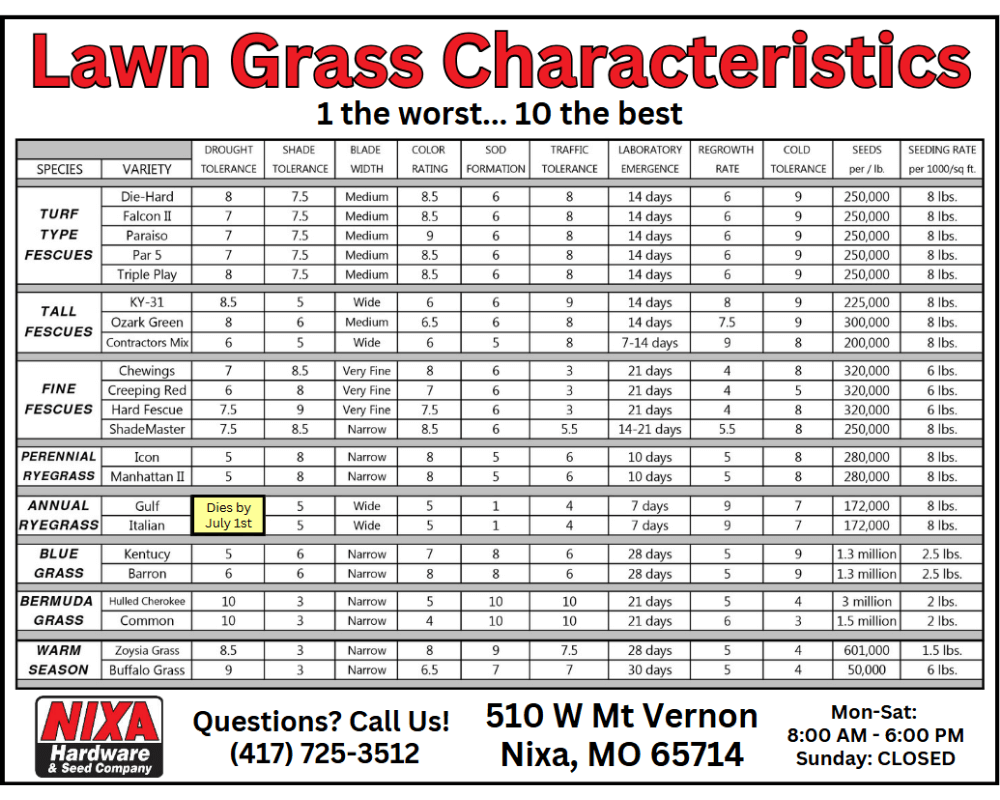
Most lawn failures around here aren’t from bad seed — they’re from the wrong seed. Fescue that looks great in a fancy catalog can struggle in southwest Missouri clay. Bermuda that thrives in a sunny Branson lawn isn’t going to do much under a canopy of post oaks. We put this chart together after watching what performs – and what doesn’t – across the kinds of yards, pastures, and properties our customers deal with every season. It scores twelve common turfgrass varieties across drought tolerance, shade, traffic, regrowth, cold hardiness, and more, so you can make a decision based on your actual conditions, not the picture on the bag.
STEPS
How to Read This Chart
Each category is scored one to ten — one being the worst performer, ten being the best. The goal isn’t to find the grass with the highest total score, it’s to find the one that matches your specific conditions. A shaded backyard in Ozark needs a different answer than a sunny front lot in Bentonville.
Start with your conditions, not the chart. Here’s the order that makes the most sense:
Sun or Shade
Shade tolerance is the hardest thing to work around. If your yard has heavy tree cover, that narrows the list fast.
Drought Tollerance
Ozarks summers are dry. A grass that needs regular water in July is a grass that needs regular attention.
Traffic
Kid’s play area or dog run gets weighted differently than a front lawn nobody walks on.
Cold Tolerance
Warm-season grasses like bermuda go dormant and brown in winter. That’s normal, but it surprises people the first year.
Seeding Rate
Once you’ve picked the variety, use the seeds-per-pound and seeding rate columns to figure out how much to buy.
STEPS
Lawn Grass Varieties for Southwest Missouri
Turf Type Fescues
(Die-Hard, Falcon II, Paraiso, Par 5, Triple Play)
Turf-type fescues are the workhorses of the Ozarks lawn. They handle the heat better than most cool-season grasses, stay green through a normal winter, and hold up reasonably well in the kind of clay-heavy soil that covers a good portion of southwest Missouri. The varieties in this group are all bred for improved drought tolerance compared to older fescue varieties, which matters when July shows up and the rain doesn’t. They perform best seeded in September, when soil temperatures have cooled enough for good germination but there’s still time to establish before frost. Plan on 8 pounds per thousand square feet and don’t rush the fall seeding window.
Tall Fescues
(KY-31, Ozark Green, Contractors Mix)
Tall fescue has been the default grass across a lot of this region for decades, and KY-31 in particular shows up on more roadsides, pastures, and older home lawns than just about anything else around here. It’s tough, tolerates shade better than most cool-season grasses, and doesn’t need much attention to survive. Ozark Green is a step up in appearance from KY-31 while keeping that same regional toughness. Contractors Mix is practical for larger areas where you need coverage fast and aren’t chasing a manicured look. The tradeoff across this group is texture. Tall fescues have a coarser blade than turf-type varieties, which some people don’t mind and others won’t live with. Know which camp you’re in before you seed.
Fine Fescues
(Chewings, Creeping Red, Hard Fescue, ShadeMaster)
Fine fescues earn their name. Narrow blade, low maintenance, and genuinely shade tolerant in a way that most grasses aren’t. ShadeMaster and Creeping Red are the most adaptable of the group, handling both shade and dry conditions well across the kinds of lots with heavy tree cover. Chewings works in similar situations but stays in a clump rather than spreading. Hard Fescue is the most drought tolerant of the four and can get by on poor soil where other grasses give up. The catch with the whole group is traffic. Fine fescues don’t bounce back well from heavy foot traffic, so they’re better suited for low-use areas, shaded side yards, or spots under trees where you’re mostly just trying to keep something green.
Perennial Ryegrass
(Icon, Manhattan II)
Perennial ryegrass establishes faster than just about anything else in this chart, which makes it useful when you need coverage quickly. A bare spot after construction, a lawn that got hammered over the summer, or an overseeding situation where you want results before fall ends. Icon and Manhattan II are both improved varieties with better disease resistance and finer texture than older perennial rye. The thing to understand about perennial ryegrass in the Ozarks is that “perennial” is relative. It survives most winters here but can thin out in a hard one or struggle through a brutal July. It works best as part of a mix or as a companion to fescue rather than a stand-alone lawn grass. Good germination rate, good color, just don’t plant it expecting it to carry long-term on its own.

Annual Ryegrass
(Gulf, Italian)
Annual ryegrass is exactly what it sounds like. It germinates fast, covers ground quickly, and is gone by summer. Gulf is the common variety and it does its job well. It’s used most often for temporary erosion control, overseeding dormant bermuda to keep color through winter, or filling in while a permanent grass establishes. The chart flags it with a “Dies by July 1st” note, and that’s worth taking seriously. Don’t plant annual rye expecting it to carry through into a permanent lawn. It’s a tool for a specific situation, not a long-term solution. At 8 pounds per thousand square feet it’s economical, and when the situation calls for fast, cheap coverage, nothing beats it.
Bluegrass
(Kentucky, Baron)
Kentucky bluegrass is one of the most recognized lawn grasses in the country, and it can do well here, but it’s the most demanding cool-season grass on this chart. It wants full sun, consistent moisture, and good soil, and it’s slower to establish than fescue or ryegrass. Baron is an improved variety with better density and disease resistance than common Kentucky bluegrass, but both varieties share the same basic requirements. In the right situation, a sunny well-maintained lawn where someone’s willing to water through dry stretches, bluegrass produces a dense fine-textured turf that’s hard to beat for appearance. In the wrong situation, like a shaded lot or compacted clay with no irrigation, it’s a frustrating grass to keep alive. The seeding rates reflect the small seed size. Two and a half pounds per thousand square feet goes further than it sounds, since there are over a million seeds per pound. Give it a good seedbed, keep it moist through germination, and don’t expect it to look like much the first season.
Bermuda Grass
(Hulled Cherokee, Common)
Bermuda is the warm-season grass most people in this region are already familiar with, whether they planted it intentionally or inherited it. It’s aggressive, drought tolerant, and handles heat and foot traffic better than anything else on this chart. Hulled Cherokee is an improved variety that establishes more reliably from seed than common bermuda. The tradeoff is dormancy. Bermuda goes brown when temperatures drop in fall and doesn’t green back up until late spring, which catches first-time growers off guard. If year-round color matters, bermuda isn’t the answer unless you’re willing to overseed it with annual ryegrass in October. It also spreads, which is either a feature or a problem depending on your situation. Keep it away from flower beds and property edges you want to maintain cleanly.
Warm Season Grasses
(Zoysia, Buffalo Grass)
Zoysia and buffalo grass round out the warm-season options and both bring something different to the table. Zoysia is the more refined of the two. Dense, slow-growing, and attractive once established, though that establishment takes patience. It handles heat and moderate drought well and holds up to foot traffic better than most. Buffalo grass is the low-maintenance option of the entire chart. It’s native to the Great Plains, thrives on minimal water, and once it’s in, it largely takes care of itself. The seeding rates reflect the difference in seed size. Buffalo grass runs around 6 pounds per thousand square feet compared to Zoysia’s 1.5 pounds. Neither variety is going to look like a golf course, but if low inputs and drought survival are the priority, both are worth considering for the right site.
Common Questions About Lawn Grass in the Ozarks
A Note From the Team
This chart was put together by the team at Nixa Hardware and Seed Co, based in Nixa, Missouri. We’ve been helping landowners, farmers, and homeowners across southwest Missouri and northwest Arkansas make sense of lawn seed decisions since 1899. If you have questions about what’s right for your specific yard situation, give us a call at (417) 725-3512 or stop in at 510 W Mt Vernon.