
In the Ozarks, alfalfa is known as the “Queen of Forages,” and for good reason. Whether you’re baling for a high-dollar horse market or looking to keep your own dairy cattle in top condition, a thick, clean stand of alfalfa is the gold standard. But let’s be honest: alfalfa can be a finicky crop if you don’t treat it right.
At Nixa Hardware & Seed Co., we’ve seen what works on local ground and what ends up as a wasted bag of seed. Success isn’t about luck; it’s about getting the chemistry and the equipment settings right before that seed ever hits the soil.
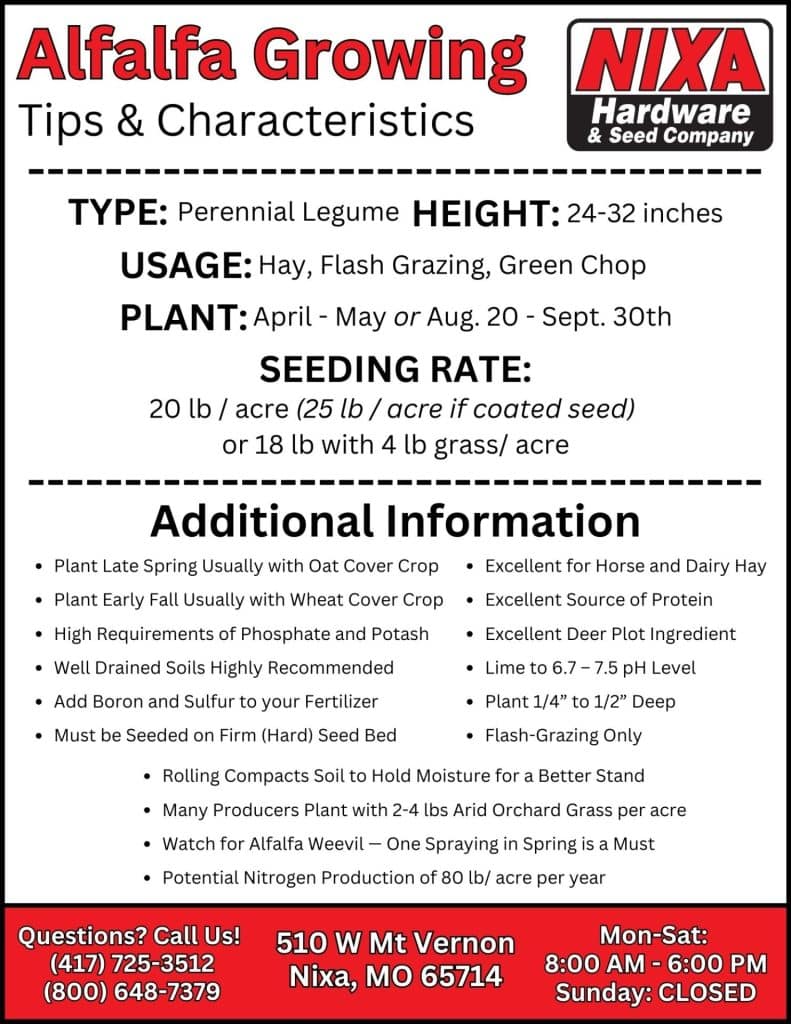
| Type: | Usage: | Plant: | Height: | Seeding Rate: |
| Hay, Flash Grazing, Green Chop | Perennial Legume | April-May*Aug. 20- Sept 30th* | 24-32 inches | 22 lb/ acre18 lb w/ 4 lb grass/ acre |
The “Queen of Forages” for a Reason
Alfalfa stays at the top of the list because of its sheer tonnage and protein potential. In a good year, a well-managed Missouri stand can produce five or more cuttings of premium hay.
Choosing Your Variety: We carry the heavy hitters for our region. If you want “old reliable,” Cimarron VL500 is hard to beat for persistence. If you’re fighting heavy weed pressure, Roundup Ready® Paramount-RR gives you the convenience of cleaning up your fields without dinging your crop.
Ozark Tough: While fescue and orchard grass check out when the July heat hits, alfalfa’s deep taproot keeps digging. It can find moisture deep in the subsoil that other grasses simply can’t reach.
Getting the Dirt Right (The Non-Negotiables)
You can buy the most expensive seed in the world, but if your soil is “sour,” it won’t grow. Southwest Missouri is notorious for acidic soil, and alfalfa won’t tolerate it.

- The pH Battle: Apply lime as needed to reach a soil pH of 6.7 to 7.5. If you haven’t put down lime in a few years, get a soil test done. Without the right pH, the nitrogen-fixing bacteria on the seed won’t work, and the plant will starve.
- The “Big Three” Plus One: Everyone knows Nitrogen, Phosphorus, and Potassium, but for alfalfa, Boron is the secret ingredient. A Boron deficiency will turn your leaves yellow and stunt your growth. We recommend a solid fertility program that prioritizes Potash and a hit of Boron every year.
From the Seed Bag to the Hay Loft
Timing is everything in the Ozarks. We generally see the best results with two planting windows: April through May or late August through September. Late-summer planting is often preferred because it gives the plants time to establish before the spring weed rush.
Making “Horse Gold”: If you’re selling hay, consider an Arid Orchard Grass mix. Adding 2–4 lbs per acre of orchard grass helps the windrows dry out faster and provides a balanced flake that horse owners pay a premium for.
The “Firm and Shallow” Rule: This is where most guys miss the mark. Alfalfa seed is tiny. If you bury it an inch deep, it’ll never see the sun. You want it 1/4” to 1/2” deep at most. Use a cultipacker or a heavy roller to make sure you have “seed-to-soil” contact. Remember the boot test: if you’re leaving deep tracks, you aren’t done rolling yet.
Defending Your Investment
The job isn’t over once the hay is up. The Alfalfa Weevil is a constant threat in the spring. Keep a close eye on your fields as the weather warms up; a well-timed spring spray is often the only thing standing between a record first cutting and a total loss.
Download the Nixa Seed Alfalfa Tech Sheet
Ready to get started? We’ve put together a concise, one-page guide with all the technical characteristics, planting rates, and variety comparisons for our top-selling alfalfa seeds.
Whether you’re putting in a small patch for your own stock or looking for bulk pricing for 100+ acres, our Wholesale Seed department has the inventory and the local know-how to help you succeed.